Summary
This page is a reference, not a verdict. The questions it covers sit at the meeting point of three bodies of law, County personnel policy, Wyoming election and ethics statutes, and the federal Hatch Act, and the answers depend on facts that only the County, the Secretary of State, and the U.S. Office of Special Counsel can establish. No official has found a violation.
Every document relied on is linked where it is cited: the complaints, the Clerk's letter, the finance reports, the statutes, the OSC opinions, the federal award records, and the exhibits as captured. Each claim carries a tag stating how well it is established. Readers are asked to open the documents and form their own view. Corrections with a document attached are welcome at the address in the footer.
Teton County Sheriff Matt Carr, a two-term Democrat seeking a third term on November 3, 2026, hired his only primary challenger, Jackson Police Officer Alberto Rojas. Rojas withdrew on May 29, the filing deadline. His resignation letter to the Town is dated May 31, two days later. On June 2, four days after the withdrawal, Carr asked commissioners to fund a new executive position for him. County call logs produced to the Jackson Hole News&Guide show Carr and Rojas in contact on April 29, May 28, and May 29. Commissioners declined to fund the position on June 30; Carr confirmed a conditional offer at the June 29 budget hearing and placed Rojas in an existing deputy position on July 6.
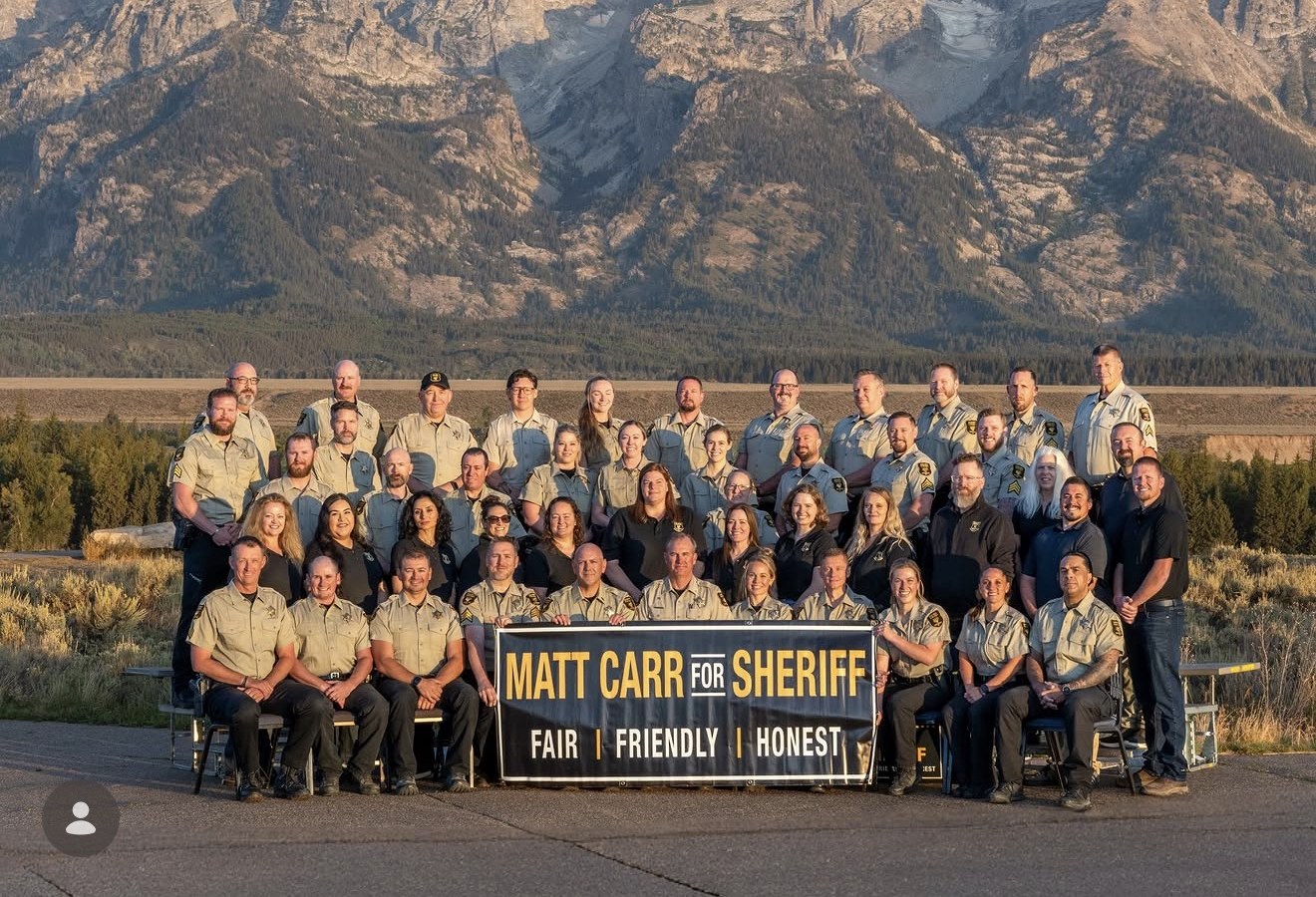
Three complaints against Carr or his office are under review at the Wyoming Secretary of State; the first was filed after County Clerk Maureen Murphy declined on September 21 to refer it to the County and Prosecuting Attorney. The second complaint concerns campaign use of County resources and uniformed deputies at campaign events. Instagram posts captured on October 24 show the uniformed group photograph above and joint posts carried on the County's official account with the campaign account, and photographs from the October 5 Republican Party forum show more than a dozen deputies attending in duty uniform and vests and Carr and Snow in uniform, with Snow addressing the forum in his. The County's own account posted the group photograph on September 10 with a First Responders Support Fund sign where the campaign banner later appeared. On October 21, Carr's Republican opponent, Deputy Eric Snow, was placed on paid administrative leave by a lieutenant, thirteen days before the election.
Three sets of rules govern the conduct described: the Teton County Policy Manual, Wyoming statute, and the federal Hatch Act. The Hatch Act applies because the Sheriff's Office does federally financed work: a Forest Service patrol agreement, FEMA tactical-equipment subawards to the County dated as recently as August 5, 2026, and school resource officers in a district that holds a federal school-safety grant. The page pairs each event with the rule it bears on, names who decides, and sets out what a finding would mean for the people involved and for the County.
This site does not state that any person has violated the law. It presents records, reporting, and the provisions that govern the conduct described, so that voters, the newspaper, and state and federal officials can judge for themselves.
Exhibits at a glance
Nine Instagram captures from October 24 and 25, 2026, four photographs from the Republican Party candidate forum at the Teton County Library on October 5, and three images from the complaint filed with the Secretary of State on October 13. Select one to go to its full image, caption, and the rule it bears on.
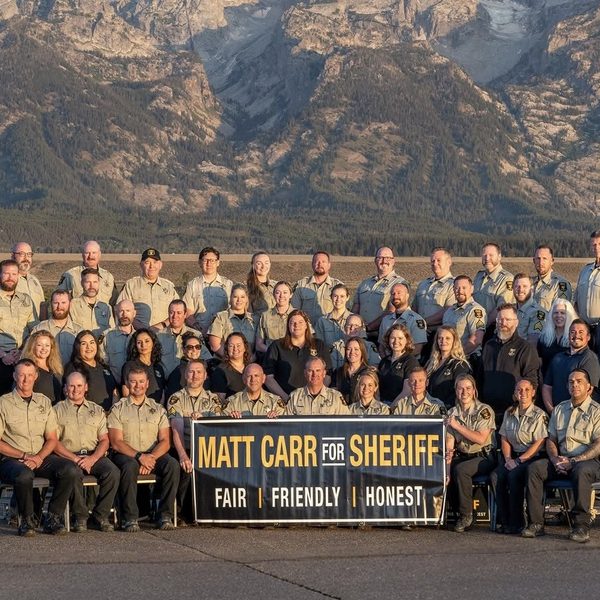 AUniformed staff with the campaign banner, September 18
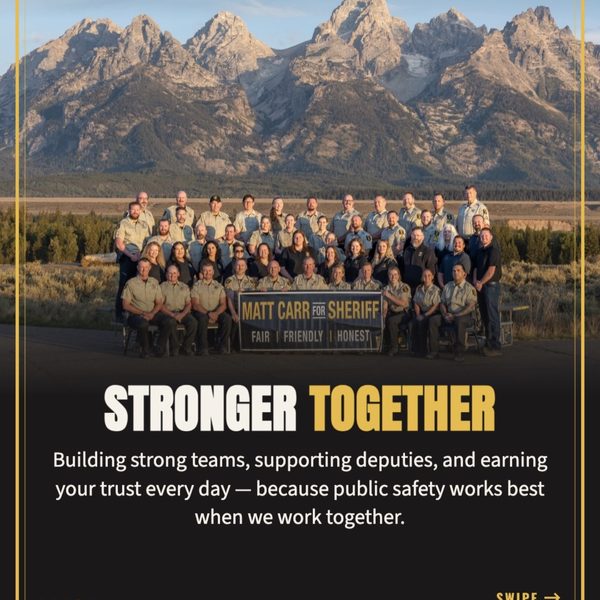 BThe same photograph as a campaign graphic, October 15
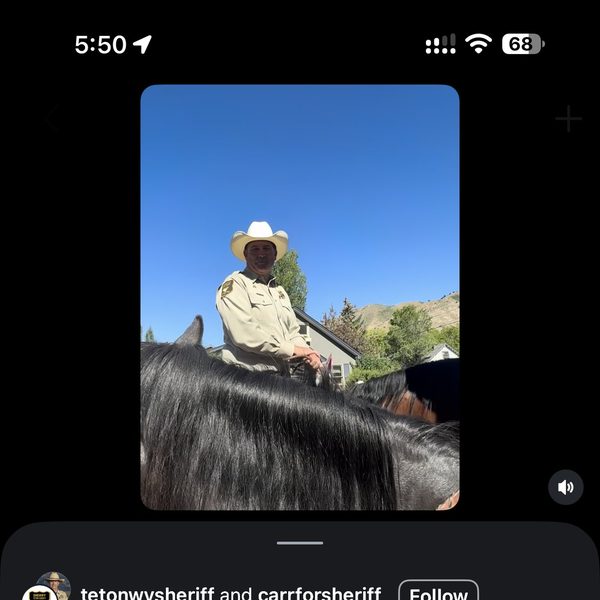 CCounty account and campaign account joint post, July 4
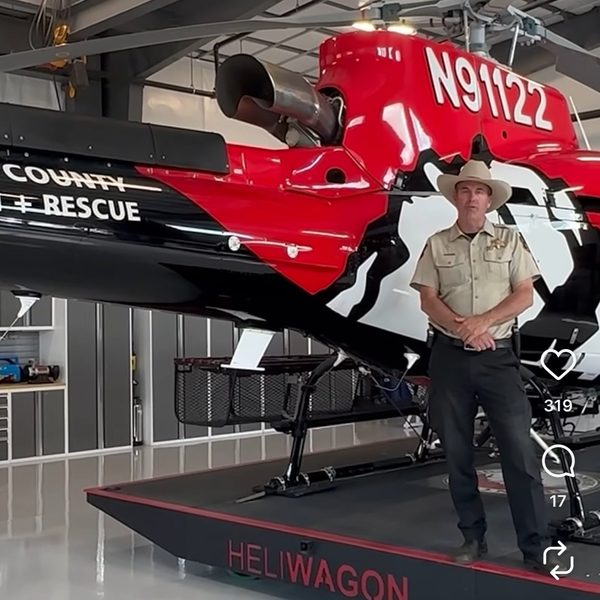 DJoint reel on the County Search and Rescue helicopter
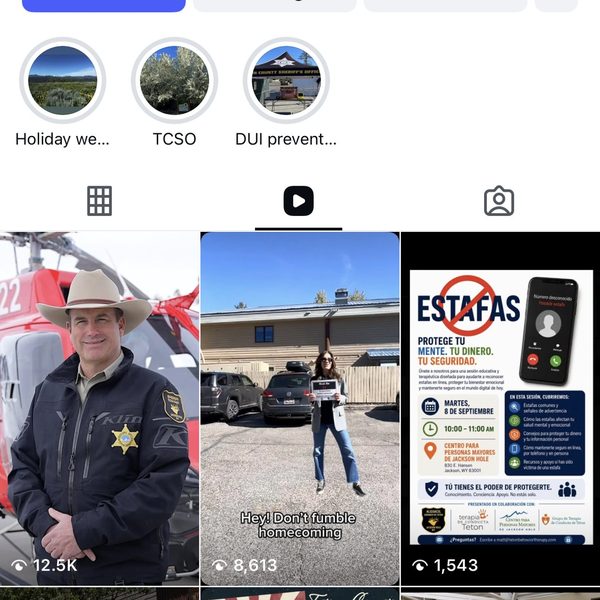 EThe County account's reels tab, October 24
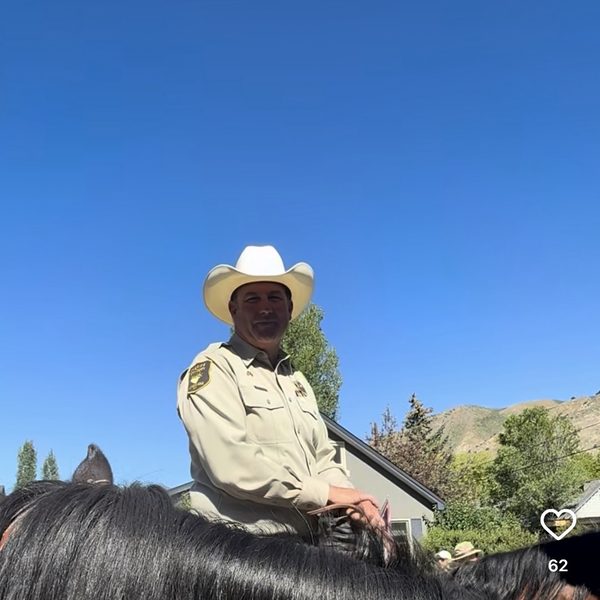 FThe July 4 post, full frame
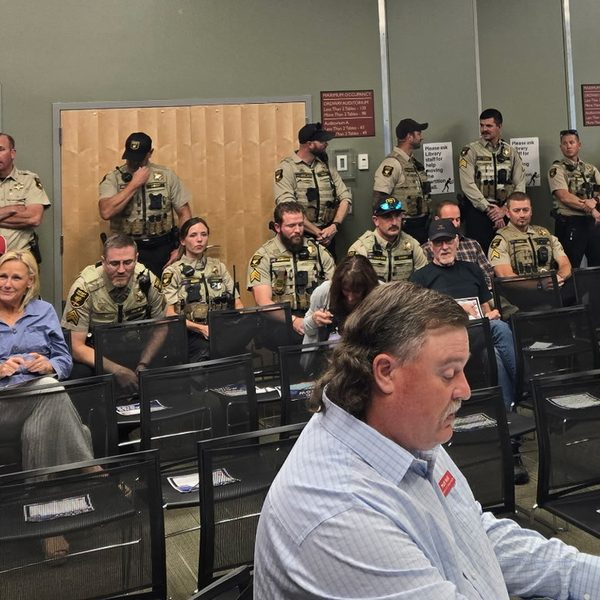 GDeputies in duty uniform at the October 5 forum, back wall
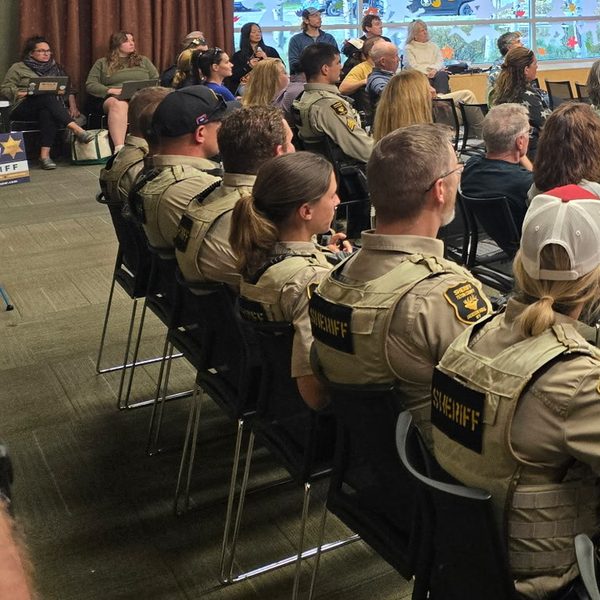 HDeputies seated in vests while Snow speaks in uniform, October 5
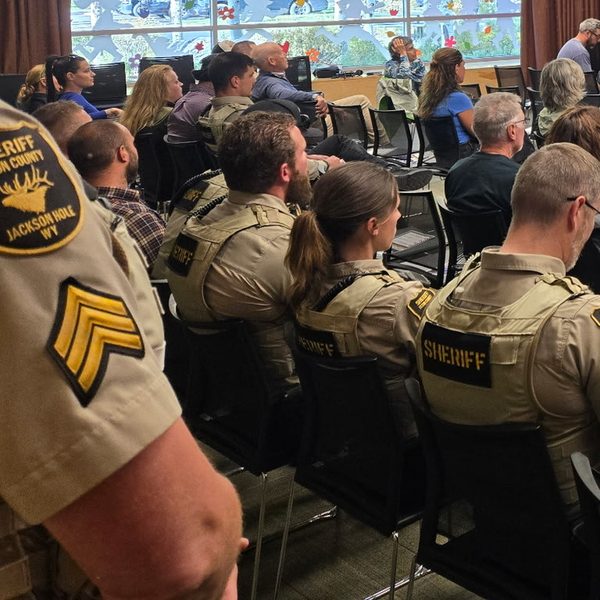 ISergeant's chevrons and seated deputies, October 5
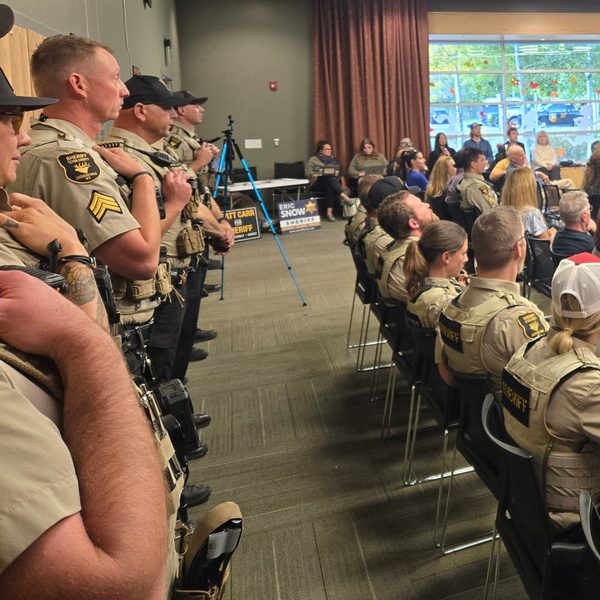 JDeputies along the side wall while Snow speaks in uniform, October 5
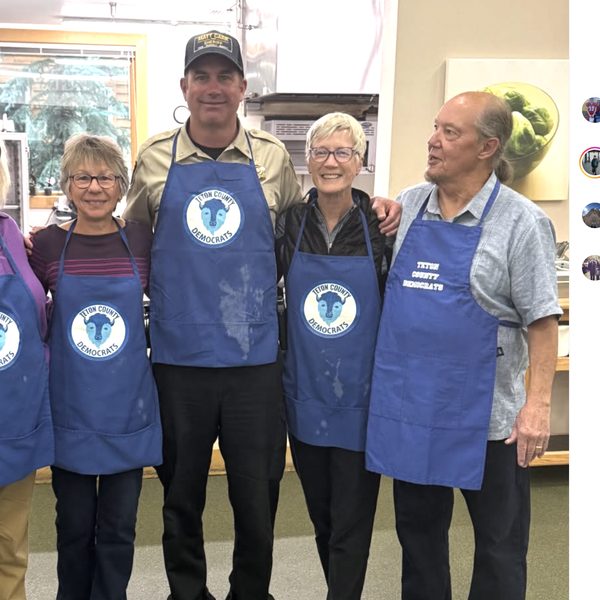 KCounty account post: Carr in uniform, campaign cap, and party apron, about October 21
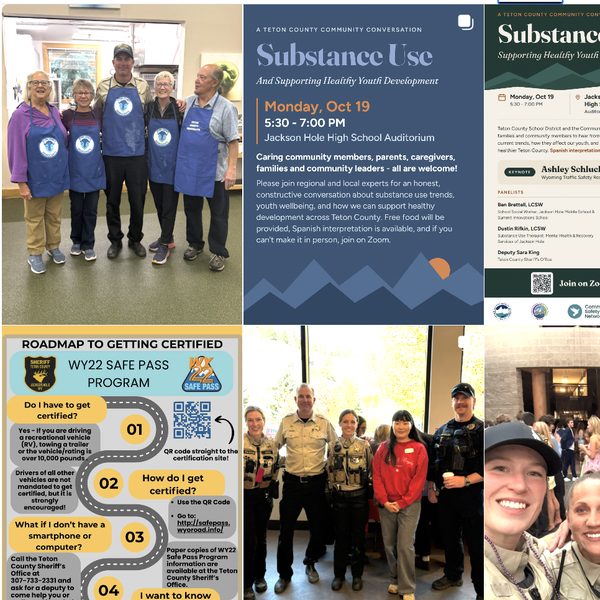 LThe County account's profile grid, October 25
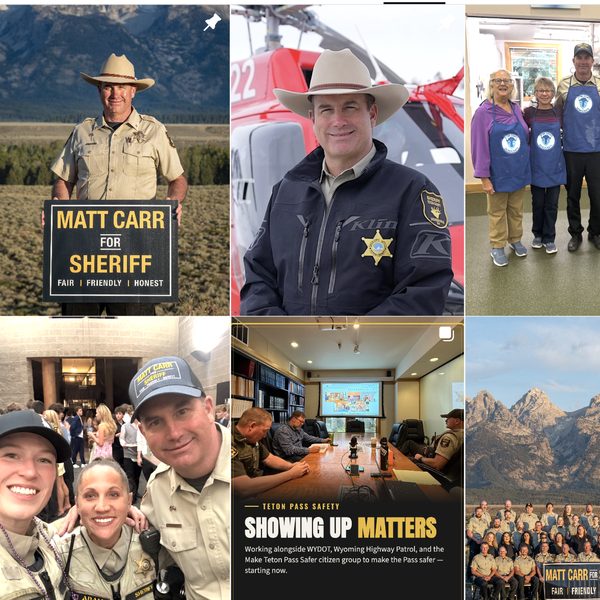 MThe campaign account's profile grid, October 25
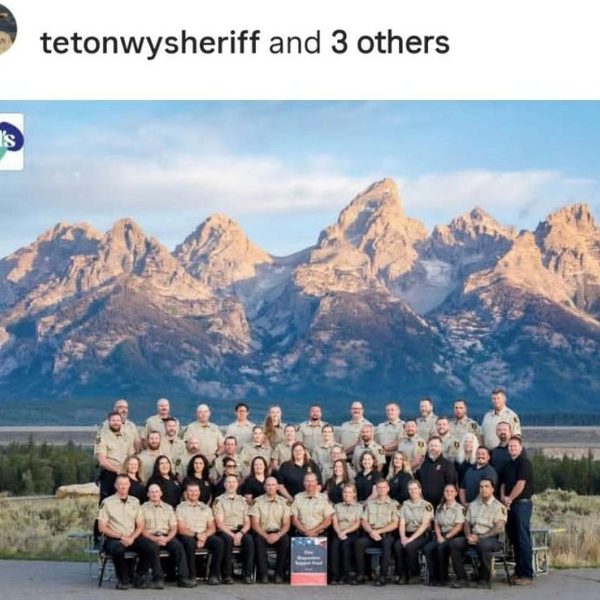 NThe same group photograph on the County account, September 10, with a fund sign in place of the banner
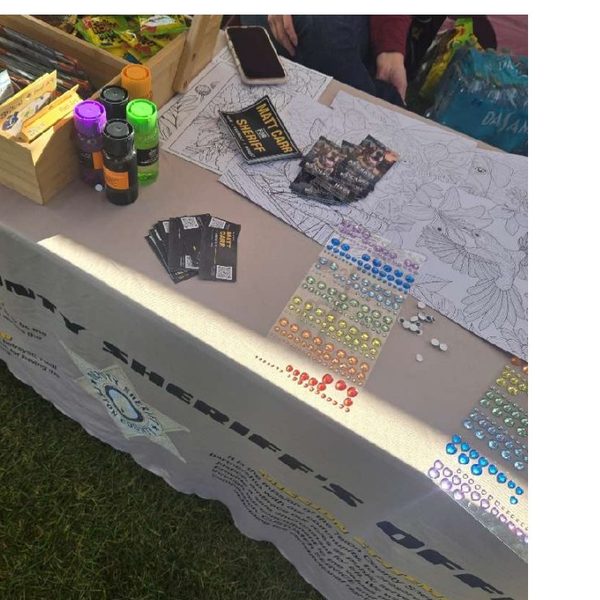 OCampaign materials on the Sheriff's Office table, Old Bill's Fun Run, September 12
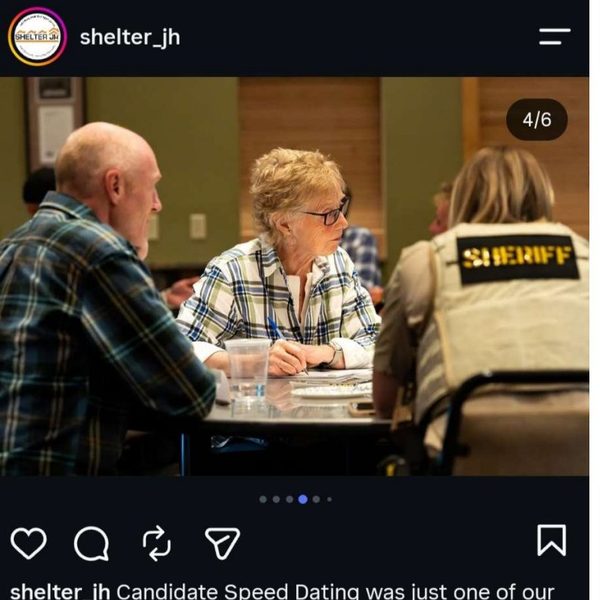 PDeputy in duty gear at the Shelter JH candidate forum, September 14
Potential violations
Each item pairs what the record shows with the rule that governs it, in plain words, and names who decides whether the rule was broken. A tag on the first line says how well the fact is established. The three parts follow the three rulebooks: the County's own policy, Wyoming statute, and the federal Hatch Act. Open a part to read its items.
Teton County policy4 items
The County's own personnel manual, adopted by the Board of County Commissioners: uniforms in campaign material, hiring without Board consent, County accounts and aircraft in campaign content, and the leave decision. The Board and the Sheriff decide these, and the outcome is discipline or a policy correction rather than a penalty.
Uniformed personnel in campaign material
- What the record shows
- AUTHOR RECORD Exhibits A and B: roughly 45 Sheriff's Office personnel in County uniform holding the campaign banner, posted by the campaign account on September 18 and reused as a campaign graphic on October 15. DERIVED Exhibit N: the County's official account posted the same group, in the same place and light, on September 10 with a First Responders Support Fund sign in place of the banner, captioned as an Old Bill's giving-season post for the three first-responder agencies. Exhibits G through J: more than a dozen deputies in duty uniform, ballistic vests marked SHERIFF, duty belts, and radios, standing along the walls and seated in the audience at the Republican Party candidate forum on October 5. Carr and Snow appear in uniform; Snow, a deputy, addressed the forum in his. AUTHOR RECORD Exhibit P: a deputy in a duty vest marked SHERIFF seated at the September 14 Shelter JH candidate forum, from ShelterJH's photographs of the event; the author attended. The second complaint's count of four uniformed deputies at that event is NOT ESTABLISHED by a record on this site.
- The rule
- Policy Manual Section 8-7(B): employees may not "campaign in their official County uniforms, County Logo attire or while wearing County identification badges or name tags," and may not "identify themselves as County employees" while campaigning. Section 8-7(A) protects political activity "confined to hours when the employee is not on duty."
- In plain words
- Deputies may support any candidate on their own time and in their own clothes. Posing in County uniform behind a campaign banner is the conduct the policy names, and so is a deputy campaigning for himself in uniform, which Exhibit H shows Snow doing. Whether anyone was told to be there, or was paid for the time, is a separate question that duty rosters and payroll records answer, and it is the question that moves the matter from County policy into statute and the Hatch Act.
- Who decides
- The Board of County Commissioners and the Human Resources Director administer the manual. For deputies, discipline rests with the Sheriff. Whether Section 8-7 binds the Sheriff himself as an elected official is for the County Attorney or the Board to say.
The hiring without Board consent
- What the record shows
- VERIFIED Carr announced a conditional offer to Rojas in June, before commissioners acted, and commissioners declined to fund the executive position on June 30. Rojas started July 6 in a deputy position already funded.
- The rule
- Policy Manual Section 2-3(B)(c): for staffing the Board has not authorized, the elected official "shall obtain the consent of the Board prior to recruiting, extending offers of employment or otherwise staffing positions."
- In plain words
- The Sheriff may hire into jobs the commissioners have already funded. For a new job, he has to get their consent before making an offer. Here the offer came first and the consent never came, so the hire went into an existing deputy slot instead.
- Who decides
- The Board of County Commissioners and the County Attorney. Section 2-3(B)(c) applies to the Sheriff by its terms.
County social media and aircraft in campaign content
- What the record shows
- AUTHOR RECORD Exhibits C, D, E, F, and K: Instagram collaboration posts carried on the County's official account together with the campaign account, the County's Search and Rescue helicopter and hangar as the setting for one of them, and, in Exhibit K, Carr in his uniform shirt and a "Matt Carr Sheriff" campaign cap wearing a Teton County Democrats apron beside four volunteers in the same party aprons, posted on the County account about October 21. Exhibits L and M, the two accounts' profile grids on the same day, show the same images on both feeds: the party-apron post in the first position on the County feed, and County public-safety material and photographs of uniformed deputies on the campaign feed.
- The rule
- Policy Manual Section 8-7(B)(b): employees may not "use their official capacity or influence to interfere with or affect the result of elections or nomination for office."
- In plain words
- An Instagram collaboration puts a post on both accounts' feeds and only works if the County account accepts it, so someone with the County's login chose to carry campaign-account content to the County's 2,099 followers, about five times the campaign account's 441. The grids show content moving both ways. The account's administrator list and whatever activity history Meta keeps would show who.
- Who decides
- The Board for the policy. The same facts fall under W.S. 9-13-105, below.
Snow's administrative leave
- What the record shows
- DERIVED Deputy Snow, Carr's opponent, was placed on paid administrative leave on October 21 by Lt. Mark Priest, thirteen days before the election, after a traffic stop that morning. Carr says he had no role in the decision. The Wyoming Highway Patrol is reviewing Snow's July 18 arrest, which the Sheriff's Office had referred to DCI and the FBI had declined to pursue. VERIFIED A recording the County produced to KHOL shows that on September 21, Lt. Priest telephoned Lt. Evan Storch of the Laramie County Sheriff's Office, who runs the state's drug recognition expert training and trained Snow, and asked him to advise Snow to pause DRE evaluations until the election ended or a pending case "clears up." Priest said on the call that he was "trying to avoid making him look bad" and called the request a "very slippery slope" during election season. Storch declined to decertify Snow without "definitive details" and later told KHOL he was surprised by the request so close to the election; he told Cowboy State Daily the call felt "a little weird, timing-wise." DERIVED Priest sent the recording to Cowboy State Daily. On it he calls the July 18 arrest "not a good arrest." He told the paper the leave was his decision and not Carr's, that the office reviews all deputies' conduct, and that "several other things" concerning insubordination had come up; Snow's attorney, Mark Jackowski, said he saw no signs of insubordination in Snow's file and that "we look forward to litigating this matter in court if necessary."
- The rule
- Policy Manual Section 6-7(B): paid administrative leave is granted by "an Elected Official or the County Commissioner's Administrator," and leave over three days "must be approved in advance by the Board, Elected Official, Department/Library Director, and the Human Resource Director must be notified." W.S. 18-3-611 protects deputies from discharge, demotion, or unpaid suspension without cause and a hearing.
- In plain words
- The policy names who may put an employee on paid leave, and a lieutenant is not on the list. If the Sheriff stepped aside, someone else with authority had to step in, and the policy says who that could be. The stop itself gives the office a stated reason to review Snow's work. The September 21 call adds a month to the record: the same lieutenant who imposed the leave had asked a state trainer, a month earlier, to have the opponent pause DRE evaluations for the duration of the election, and said on the recording that he knew what it looked like. The open questions are who made the October 21 decision, when, on whose authority, and why the July arrest, under outside review for months, drew no leave.
- Who decides
- The Board of County Commissioners and Human Resources for the policy; the Highway Patrol review for the July 18 arrest.
Wyoming statute5 items
The Election Code, the Ethics and Disclosure Act, and the criminal code: the job offer and the withdrawal, employer control of employees' political activity, public resources in campaign content, the campaign's finance reports, and the Clerk's decision on the first complaint. The County and Prosecuting Attorney, a special prosecutor from another county, or the Attorney General decides these, and the penalties run from civil fines to a felony.
The job offer and the withdrawal
- What the record shows
- DERIVED Carr and Rojas spoke on April 29, May 28, and May 29. VERIFIED Rojas withdrew on May 29, and Carr asked for a position for him on June 2. NOT ESTABLISHED What was said on the calls. Carr says he "did not offer Rojas a job to get him to drop out of the race" and cannot recall what the calls covered. No record yet shows what was said.
- The rule
- W.S. 22-26-118 makes it a misdemeanor to cause a candidate to withdraw by "making it a condition of employment, business or patronage, that such candidacy or election shall not be accepted." W.S. 6-5-107, official misconduct, reaches a public servant who, with intent to obtain a pecuniary benefit or maliciously to cause harm to another, knowingly commits an unauthorized act relating to official duties.
- In plain words
- A person may not tell a candidate, in effect, "you can have the job if you drop out." A job offer by itself is lawful; the offense is tying the job to leaving the race. The texts and call records would show which of those happened. If the job was the consideration, Rojas is the other party to the agreement rather than a witness to it.
- Who decides
- The County Clerk screens complaints and refers those with merit to the County and Prosecuting Attorney, who decides whether to charge. The Secretary of State can refer a complaint to the Attorney General. Any person may report the conduct directly to the County Attorney as a possible crime.
Employer control of employees' political activity
- What the record shows
- AUTHOR RECORD Exhibit A shows the September 18 attendance, and Exhibits G through J show deputies in full duty kit at the October 5 forum, which the second complaint says deputies were encouraged to attend. NOT ESTABLISHED Whether the personnel were scheduled, directed, on duty, or paid for either event.
- The rule
- W.S. 22-26-111(a)(ii), intimidation, a felony: "Soliciting the contribution of funds, other items of value or election assistance to the campaign of any candidate ... by use of threats of physical violence or any form of economic or official retaliation." W.S. 22-26-116, a misdemeanor: an employer making or enforcing "any order, rule, regulation or policy forbidding or preventing any employee from becoming a candidate for public office" or "controlling or attempting to control such employee's vote."
- In plain words
- A sheriff may ask for support and may accept it; he may not obtain it by letting deputies understand their standing depends on it, and he may not bar a deputy from running or direct how a deputy votes. Ballistic vests and duty belts are issued equipment worn on shift, so the October 5 photographs raise the question whether the deputies were on duty at a partisan forum. Duty rosters, payroll codes, and any message to staff about either event show which of those happened.
- Who decides
- The County and Prosecuting Attorney, a special prosecutor from another county if he has a conflict, or the Attorney General on referral from the Secretary of State.
Public resources in campaign content
- What the record shows
- AUTHOR RECORD Exhibits C through F and K: the County's account, helicopter, and hangar in campaign-account content, and the County account carrying a post with a campaign cap and partisan party aprons. DERIVED Exhibit N: the group photograph came from a Sheriff's Office photo session, posted by the County account on September 10 with a fund sign; the campaign version with the banner and a solo shot of Carr with a yard sign from the same session followed. DERIVED Exhibit O: campaign cards and a "Matt Carr for Sheriff" sign on the Sheriff's Office table under the County tent at Old Bill's Fun Run on September 12. NOT ESTABLISHED Who paid the photographer, and whether personnel were on the clock for the session.
- The rule
- W.S. 9-13-105(b), the Ethics and Disclosure Act: a public official or employee "shall not use public funds, time, personnel, facilities or equipment for political or campaign activity unless the use is" authorized by law or "properly incidental to another activity required or authorized by law" with the entity reimbursed for any additional cost. Section 9-13-105(a) applies the same bar to use "for his private benefit or that of another." W.S. 6-5-110, wrongful appropriation: converting public property "to his own use or any use other than the public use authorized by law."
- In plain words
- The County's Instagram account, its helicopter, its hangar, its event tent, and a department photo session belong to the public. If the County paid a photographer for a department photograph and the campaign used the session for its banner shot, public money bought campaign material. The photographer's invoice, the County's payment, and the duty status of the people in the frame would show it one way or the other. The campaign's primary and general finance reports list no expenditure for photography and no in-kind contribution.
- Who decides
- The County and Prosecuting Attorney for the Ethics Act and for 6-5-110, or a special prosecutor or the Attorney General on referral.
Campaign finance reports
- What the record shows
- VERIFIED Motorola Solutions, Inc. PAC's 2026 primary report to the Secretary of State, filed August 10, lists a $1,000 contribution to "CARR FOR SHERIFF," address "TETON VILLAGE, WY 83025," on July 6, 2026. The committee's primary report, received by the Clerk August 12, lists "Motorola" $1,000 and "Nick Agopian" $500, both dated July 15, as "personal contributions by candidate," with no addresses; the line for contributions from PACs reads $0.00. The committee's general report, received October 27, lists the same two amounts again, dated "Aug 2026," as contributions from individuals, with Motorola's address given as Chicago, IL, and the amendment box unmarked. On the general report, forty-one contributions carry a month and no day; seventeen expenditures carry no address and one carries a date; $1,500 is entered as "Anonymous Cash Contributions" with no date and no signature on the attestation the form requires; and the itemized contributions total $42,250 against a stated $42,150. Both reports carry the candidate's certification that the statement is "true, correct and complete." Neither report lists an expenditure for photography or for legal counsel.
- The rule
- W.S. 22-25-106(c): reports "shall set forth the full and complete record of contributions," including "the date of each contribution of one hundred dollars ($100.00) or more, any expenditure or obligation, the name of the person from whom received or to whom paid and the purpose." W.S. 22-25-106(k): reports "shall be filed under penalty of perjury." W.S. 22-25-102 sets the sources a candidate may accept from and the limits.
- In plain words
- A PAC contribution is lawful and has its own line on the form. The PAC reported the gift to the state with the recipient, the address, the day, and the amount. The committee reported it twice, on two different lines, under two different dates, and never on the line for what it was. Of the three documents, only the contributor's report records a day. The absence of any photography or legal expense bears on two other items: who paid for the September 18 photo session, and where the Sheriff's legal advice on his campaign conduct came from.
- Who decides
- The County Clerk receives the reports. The Secretary of State administers Chapter 25 and may refer a violation to the Attorney General; a false statement under 22-25-106(k) is a matter for a prosecutor.
The Clerk's decision on the first complaint
- What the record shows
- VERIFIED A complaint was filed with the County Clerk on August 21. On September 21 the Clerk declined to refer it, in a two-page letter available here as sent. She wrote that "as I am not a lawyer, I also retained outside counsel to review the complaint at the firm of Crowley Fleck Attorneys in Casper, Wyoming"; that W.S. 22-26-109 bribery reaches only inducements to vote or refrain from voting; that under 22-26-118 "even if the Clerk were to accept the allegation that Sheriff Carr offered Mr. Rojas a job if he would drop out of the race, that is not conduct prohibited by 22-26-118" because no threat of loss was alleged; and that the statute "does not vest a clerk with the authority to refer or even review complaints that allege conduct that falls outside of the limited purview of Title 22." The complainant then filed with the Secretary of State.
- The rule
- W.S. 22-26-121(b): if the county clerk "finds that the complaint has merit and suspects a violation of the Election Code, the county clerk shall refer the complaint to the district attorney."
- In plain words
- Complaints about a county candidate go to the county clerk first, and the clerk decides whether they go any further. The clerk is an elected official who works alongside the sheriff. The Clerk's letter quotes both clauses of 22-26-118 and analyzes the first, finding no threat of lost employment alleged; it does not discuss the second clause, "making it a condition of employment ... that such candidacy or election shall not be accepted," which is the language that bears on an offer of a job in exchange for withdrawing. When a clerk declines, the complaint does not move to another county. The complainant can file with the Secretary of State, who can send it to the Attorney General, or can report the conduct directly to the County and Prosecuting Attorney. If the County Attorney's office has a conflict, he asks the Board of County Commissioners to appoint a prosecutor from another county. The statute gives the clerk discretion, so a decision not to refer is itself no violation.
- Who decides
- The Secretary of State and the Attorney General for the three pending complaints; the County and Prosecuting Attorney, or a special prosecutor from another county, for anything reported to him directly.
The federal Hatch Act5 items
The federal law for state and local employees whose work is financed in part by federal grants: whether the Sheriff's Office is covered, directed or coerced attendance, use of official authority to affect the election, the pending case and OSC opinions that set the standards, and what the Act allows the Sheriff as an elected official. The U.S. Office of Special Counsel decides, no Wyoming office is involved, and the penalty falls on the County's federal grants.
Whether the Sheriff's Office is covered
- What the record shows
- VERIFIED USAspending.gov lists a Forest Service cooperative law enforcement agreement paid to "TETON COUNTY SHERIFF" from 2017 through January 2022, FEMA State Homeland Security subawards to the County for tactical team equipment and training in 2018, 2021, 2023, 2024, and 2026, including $100,000 dated August 5, 2026 for ballistic armor, night vision, encrypted radios, and breaching tools, and a $416,150 Stronger Connections school-safety award to the School District in January 2025, whose only school resource officers are Sheriff's deputies. The County's own staff report of November 15, 2022 records a $73,669.50 U.S. Department of Homeland Security cybersecurity grant, through the Wyoming Office of Homeland Security, for the Sheriff's Office's firewall, switches, wireless access points, and laptops, presented to the Board by Carr. The full list is in Federal awards.
- The rule
- 5 U.S.C. 1501(4): a covered employee is one "whose principal employment is in connection with an activity which is financed in whole or in part by loans or grants made by the United States or a Federal agency."
- In plain words
- Partial funding is enough, and the test looks at the employee's duties rather than the source of the paycheck. A deputy on forest patrol under the Forest Service agreement, a deputy on the grant-equipped tactical team, and a deputy assigned full time to schools whose safety program draws federal money would each meet the test on OSC's reading, and OSC has pleaded in Rosado that a sheriff who oversees federally financed activity is covered through the employees who do it. The 2022 cybersecurity grant financed the office's own network, the equipment every employee of the office works on, and the Sheriff asked the Board to accept it. A deputy whose assignment has no federal connection is not covered.
- Who decides
- The Office of Special Counsel, case by case, from the County's grant agreements and position records. Anyone may ask OSC for a written advisory opinion on coverage without filing a complaint.
Directed or coerced attendance
- What the record shows
- AUTHOR RECORD Exhibit A, roughly 45 uniformed personnel with the campaign banner on September 18; Exhibits G through J, more than a dozen deputies in duty uniform and vests at the October 5 forum, with Carr and Snow in uniform. DERIVED Exhibit N shows the group photograph was a Sheriff's Office session the County account published first. DERIVED Carr told KHOL he did not ask deputies to attend the October 5 forum and was "[as] surprised as anyone"; Priest said deputies were not asked and "Everybody wanted to be there." NOT ESTABLISHED Whether attendance at either event was scheduled, directed, on duty, or organized by a supervisor. The complaint filed October 13 states that a shift change preceded the October 5 forum, that deputies arrived in official vehicles, and that Carr told an attendee he knew some attending deputies were on duty; those statements are the complainant's and are not shown by a record on this site.
- The rule
- 5 U.S.C. 1502(a)(2): a covered employee may not "directly or indirectly coerce, attempt to coerce, command, or advise a State or local officer or employee to pay, lend, or contribute anything of value to a party, committee, organization, agency, or person for political purposes."
- In plain words
- Time and appearance in a campaign photograph count as something of value. OSC's 2015 advisory opinion on a sheriff's reelection letter states the standard: a supervisor asking a subordinate to support a political cause is "inherently coercive," and the Act "would prohibit any sheriff's office supervisor, including the sheriff or the chief deputy," from asking subordinates to take part. OSC's 2012 advisory opinion on elected sheriffs states the same rule with its source: "Where the supervisor-subordinate relationship exists, no particular words are required to establish coercion because virtually any language can be threatening. Special Counsel v. Gallagher, 44 M.S.P.R. 57, 76 (1990). Thus, sheriffs should not ask their employees to contribute to political campaigns." The request itself is the violation; no threat has to be shown. Voluntary off-duty attendance violates nothing; a deputy who was asked to attend is a witness, and the supervisor who asked is the subject.
- Who decides
- OSC investigates; the Merit Systems Protection Board decides a contested case.
Use of official authority to affect the election
- What the record shows
- AUTHOR RECORD Exhibits C through F and K, the County account carrying campaign-account content, including a post of the Sheriff in uniform shirt, campaign cap, and Teton County Democrats apron. VERIFIED The Rojas hiring sequence. VERIFIED The September 21 recorded call in which Lt. Priest asked the state DRE trainer to have Snow pause evaluations until the election ended. DERIVED The October 21 leave, imposed by the same lieutenant.
- The rule
- 5 U.S.C. 1502(a)(1): a covered employee may not "use his official authority or influence for the purpose of interfering with or affecting the result of an election or a nomination for office."
- In plain words
- OSC treats an agency's official social media account as official authority. The hiring power, the leave power, and a lieutenant's call to another agency about a subordinate's certification are official authority as well. The question for each is purpose: whether the County account, the job, the call, or the leave was used to affect the race. On the September 21 recording the lieutenant tied the request to the election in his own words, and in the final week of the campaign the County provided the recording to KHOL on request and Priest sent it to Cowboy State Daily. The administrator list, the hiring file, the recording, and the leave file carry the answer.
- Who decides
- OSC and the Merit Systems Protection Board.
The pending case, OSC advisory opinions, and the 2012 amendment
| Authority | What it holds | How it bears here |
|---|---|---|
| OSC advisory opinion, letters of support for a sheriff, October 29, 2015 | Employees may sign a support letter in a personal capacity. If they are covered, the Act "would prohibit any sheriff's office supervisor, including the sheriff or the chief deputy," from asking them to sign or circulating it, because a supervisor's request to a subordinate is "inherently coercive." Coverage "is not dependent on the source of an employee's salary." | The standard for the September 18 photograph and the October 5 attendance: whether any supervisor asked. |
| OSC advisory opinion, elected sheriffs' use of title and uniform, February 29, 2012 | An incumbent elected sheriff may campaign in uniform and use the title; the candidacy exemption covers him. The coercion and official-authority provisions still apply: "Asking a subordinate to make a political contribution or volunteer for a political campaign is considered inherently coercive," and "where the supervisor-subordinate relationship exists, no particular words are required to establish coercion because virtually any language can be threatening." | Carr's own uniform and title are not the issue; what he asked of deputies and what he did with County accounts, hiring, and leave are. |
| OSC guidance, Hatch Act Modernization Act of 2012, for state and local employees | Most state and local employees may now run for partisan office "unless the employee's salary is paid for completely by federal loans or grants." The Act left intact the "prohibitions on coercive conduct or misuse of official authority for partisan purposes," and coverage continues for an employee who "works in connection with a program financed in whole or in part by federal loans or grants, even if the connection is relatively minor." | Candidacy is open to the Sheriff and to any deputy; the two prohibitions that remain are the two this record concerns, and the coverage test is the one applied in the Federal awards section. |
| Special Counsel v. Rosado and Special Counsel v. Pascal, MSPB, filed December 18, 2025, pending (OSC announcement) | Sheriff and undersheriff of Chesapeake, Virginia charged under 1502(a)(1) and (a)(2): agency events used for campaign promotion, ticket quotas, employees placing signs and working polls, employees in campaign videos identified with the office, pressure to attend party meetings. Coverage pleaded on oversight of activities financed by a Justice grant and federal task-force work, regardless of salary source. Removal sought. | The closest current case on both counts and on the oversight theory of coverage. |
What the Act allows the Sheriff
- The rule
- 5 U.S.C. 1502(c)(4) exempts "an individual holding elective office" from the Act's bar on candidacy. OSC's August 14, 2018 opinion on elected sheriffs campaigning in uniform says an incumbent may attend campaign events in uniform and may drive an agency-issued vehicle to one.
- In plain words
- Carr may run, may campaign in uniform, and may use his title. The exemption covers his own candidacy and nothing else; the coercion and official-authority provisions still apply to him. OSC filed complaints with the Merit Systems Protection Board in December 2025 against the sheriff and undersheriff of Chesapeake, Virginia, on those two provisions, alleging ticket quotas for fundraisers, employees placing signs and working polling sites, employees in campaign videos identified with the office, and pressure to attend party meetings. OSC pleaded that the sheriff was covered because he oversaw activities financed in part by a Department of Justice grant and federal task-force work, without regard to who paid his salary, and asked for his removal. The cases are pending.
Roles
Who controls what, which rules reach each of them, and who decides. The Board of County Commissioners appears here because every federal dollar that reaches the Sheriff's Office arrives through the County, and the Board signs for it.
| Who | What they control | Rules that reach them | Who decides |
|---|---|---|---|
| Sheriff Matt Carr | Hiring, assignment, and discipline of deputies (W.S. 18-3-602); the office's social media; the agency's operations | W.S. 22-26-118, 22-26-116, 22-26-111; W.S. 9-13-105, 6-5-107, 6-5-110; 5 U.S.C. 1502(a)(1) and (a)(2) if covered; Policy Manual 2-3(B)(c) and, if it binds him, 8-7 | County Attorney or special prosecutor; Attorney General; OSC; the voters; the Governor and the district court under W.S. 18-3-902 |
| Deputies in the photograph | Their own off-duty time | Policy Manual 8-7(B) if on duty or in uniform while campaigning. The Hatch Act does not reach a covered employee who attends voluntarily off duty. | The Sheriff, for discipline |
| Supervisors who scheduled or organized attendance, if any | Duty rosters, assignments, messages to staff | W.S. 22-26-111(a)(ii); 5 U.S.C. 1502(a)(2) if covered; Policy Manual 8-7(B)(b) | County Attorney or special prosecutor; OSC; the Sheriff |
| Lt. Mark Priest | The October 21 leave decision, as reported | Policy Manual 6-7(B), which does not list a lieutenant among those who may grant paid leave; 5 U.S.C. 1502(a)(1) if covered and if the purpose was electoral | The Board and Human Resources; OSC |
| Deputy Eric Snow | His own candidacy and campaign | Policy Manual 8-7(B)(a) for campaigning in uniform | The Sheriff, for policy |
| Alberto Rojas | His withdrawal and his acceptance of the job | W.S. 22-26-118 as the other party, if the job was the consideration for withdrawing | County Attorney or special prosecutor; Attorney General |
| Board of County Commissioners | The County budget, including Sheriff's Office positions (W.S. 18-3-504); the Policy Manual; consent under 2-3(B)(c); every federal award, signed as grantee with a written Hatch Act assurance; appointment of a special prosecutor on the County Attorney's request; outside counsel | 2 C.F.R. Part 200 and the award terms, as grantee. No rule on this page makes the Board itself a violator; its exposure is the County's federal money and its duty is to find out whether its certification holds. | The Forest Service, FEMA, and the State of Wyoming as pass-through, for award compliance; the voters |
| County Clerk Maureen Murphy | Screening Election Code complaints against county candidates; County records | W.S. 22-26-121(b) gives her discretion; complaints about the Clerk go to the district attorney under 22-26-121(c) | The Secretary of State, for complaints that bypass her; the voters |
| County and Prosecuting Attorney | Charging decisions under the Election Code, Ethics Act, and criminal code; advice to the Board and the Clerk; requesting a special prosecutor when conflicted. The Sheriff states that his campaign conduct was checked with this office. | Conflict rules of the Wyoming Rules of Professional Conduct | The Board, on a request for conflict appointment; the Attorney General |
| Teton County School District No. 1 | The SRO contract with the Sheriff's Office; the Stronger Connections and Title IV-A grant budgets | The federal award terms, as grantee, if SRO costs are charged to a federal grant | The Wyoming Department of Education; the School Board |
| Wyoming Secretary of State | The two pending complaints | Refers qualifying complaints to the Attorney General | |
| U.S. Office of Special Counsel | Hatch Act investigation, warning letters, prosecution before the Merit Systems Protection Board, advisory opinions on coverage | The Merit Systems Protection Board, in a contested case |
Consequences of a finding
What each rulebook can produce if the officials who decide find a violation. None of these outcomes has occurred.
For Sheriff Carr
- W.S. 22-26-118 and 22-26-116: misdemeanors under 22-26-112, up to six months, a fine up to $1,000, or both, if knowing and willful.
- W.S. 22-26-111 and 22-26-109: felonies under 22-26-101, up to five years, a fine up to $10,000, or both.
- W.S. 6-5-107: misdemeanor, a fine up to $5,000. W.S. 6-5-110: misdemeanor, up to one year, a fine up to $1,000, or both. W.S. 9-13-105: misdemeanor, a fine up to $1,000, under 9-13-109(a); a violation is "sufficient cause" for removal from office under 9-13-109(b).
- Hatch Act: for an elected official the Board cannot remove, the remedy runs against the County's federal money, below. OSC's usual first outcome in a state or local case is a warning letter, which goes into the County's grant file.
- Removal from office runs through W.S. 18-3-902, on a verified complaint of qualified electors or the Board to the Governor, who may direct the Attorney General to petition the district court; the court decides, with or without a jury, within thirty days of the answer. Findings from any of the routes above would be facts such a petition could set out, and W.S. 9-13-109(b) makes an Ethics Act violation "sufficient cause" for removal. A felony conviction vacates the office under Wyoming law.
For deputies and supervisors
- Policy Manual 8-7(B): discipline by the Sheriff. Section 6-7(B): the leave decision can be reviewed by the Board and Human Resources.
- W.S. 22-26-111(a)(ii) reaches a supervisor who obtained election assistance by threat of official retaliation, as a felony; 22-26-116 reaches an employer rule against a deputy's candidacy or vote, as a misdemeanor.
- Hatch Act, for a covered deputy or supervisor found to have coerced others or used official authority: the Merit Systems Protection Board can order removal. If the County does not remove the employee within 30 days, the federal agencies withhold from their grants to the County an amount equal to two years of that employee's salary, under 5 U.S.C. 1506(a).
- A deputy who attended voluntarily and off duty faces no consequence under any rule on this page.
For Deputy Snow
- Policy Manual 8-7(B)(a): discipline by the Sheriff for campaigning in uniform, the same rule that reaches the personnel in Exhibit A.
For Alberto Rojas
- W.S. 22-26-118 reaches both parties to an agreement that conditions employment on leaving a race. The same penalty applies.
For the County
- A Hatch Act withholding under 1506(a) is taken from the Board's budget, at the agencies' discretion, from the Forest Service agreement, the FEMA subawards, or any other federal award to the County. For a sheriff's salary the amount is on the order of two years' pay.
- The SF-424B assurances that federal applicants sign include a Hatch Act assurance; whether the County signed one for each subaward, or the State's subaward agreement carries an equivalent term, is in the agreements themselves. A finding puts that certification before the awarding agencies, which under 2 C.F.R. 200.339 may disallow costs, withhold future awards, or terminate.
- The County's annual single audit must disclose a known compliance finding, which follows the County into later applications.
- The State of Wyoming, as the FEMA pass-through, may suspend a subrecipient under its own subaward terms.
For the School District
- If SRO costs are charged to the Stronger Connections grant and an SRO deputy is found in violation, the same withholding and a disallowed-cost finding from the Wyoming Department of Education apply to that award.
What a finding cannot do
A Hatch Act or Ethics Act finding cannot stop the election, change its result, or remove the Sheriff. An Election Code conviction does not undo the hire. The voters decide the office on November 3; the rules above decide what follows for the people and the money involved.
Timeline
Open this section
Thirty-six dated events from 2017 to November 3, 2026, each with the record or report it rests on. Square markers are federal funding events; tan markers are exhibits.
- The Forest Service pays the Sheriff's Office $58,620 under cooperative law enforcement agreement 17LE11040300010 for patrol on the Bridger-Teton, with "TETON COUNTY SHERIFF" on each transaction.VERIFIED USAspending.gov
- Carr presents to the Board of County Commissioners for acceptance a $73,669.50 U.S. Department of Homeland Security cybersecurity grant, through the Wyoming Office of Homeland Security, for the Sheriff's Office's firewall, switches, wireless access points, and laptops. Carr is the presenter.VERIFIED County staff report, agenda item 5
- The School District ends its SRO contract with the Jackson Police Department, leaving the Sheriff's Office as its only provider: $100,000 a year for two deputies across seven schools, with a third planned.DERIVED News&Guide, spring 2024
- The School District receives a $416,150 Stronger Connections school-safety award through the Wyoming Department of Education, with an obligation window of February 6, 2024 to September 30, 2026. The State's guidance lists school resource officers among allowable hires.VERIFIED USAspending.gov; WDE guidance
- Carr tells commissioners two graveyard deputies are urgently needed.DERIVED News&Guide, June 30
- Rojas registers to vote in Teton County as a Democrat, with no prior registration.DERIVED News&Guide, June 17 and 27
- Carr and Rojas speak by phone, per County call logs.VERIFIED County production reported June 17
- Police Chief Michelle Weber and Carr have a "courtesy conversation" about Rojas.DERIVED News&Guide, June 17
- Candidate filing opens. Rojas files as a Democrat for Sheriff.VERIFIED County Clerk, per News&Guide
- Carr and Rojas speak by phone, per County call logs.VERIFIED County production reported June 17
- Filing deadline. Rojas withdraws. Deputy Eric Snow files as a Republican. Rojas meets Chief Weber about resigning.DERIVED News&Guide, June 3 and 17
- Date on Rojas's resignation letter to the Town.DERIVED News&Guide, June 17
- Carr emails commissioners requesting a new executive-level position for Rojas.DERIVED News&Guide, June 3
- Rojas turns in keys, weapons, and Town cellphone.DERIVED News&Guide, June 17
- The County produces screenshots of Carr's cellphone call logs and one scheduling text, to the News&Guide.DERIVED News&Guide, June 17
- Budget hearing. A resident's letter asking whether there was a "quid pro quo" is read. Commissioner Len Carlman: "I don't like the smell of it." Carr confirms a conditional offer to Rojas.VERIFIED Public meeting; News&Guide and KHOL, June 30
- Commissioners adopt the FY2027 budget with $198,000 for two deputies and tell Carr it cannot fund an executive post.VERIFIED Budget adoption; News&Guide
- The County's Instagram account and the campaign account publish a joint collaboration post of Carr in uniform at the parade.AUTHOR RECORDExhibit C
- Rojas joins the Sheriff's Office as a deputy. The same day, Motorola Solutions, Inc. PAC records a $1,000 contribution to Carr for Sheriff, reported to the Secretary of State on August 10 and reported by the committee as the candidate's own money on July 15.DERIVED News&Guide, October 14
- Snow arrests a 20-year-old on suspicion of drug-impaired driving. The charge is dismissed two days later. The Sheriff's Office later refers the arrest to DCI.DERIVED News&Guide, October 22
- The State of Wyoming reports a $100,000 FEMA State Homeland Security subaward to the County under EMW-2025-SS-05015 for ballistic helmets, rifle-related body armor, encrypted communications, night vision devices, and breaching tools. The SF-424B assurances that federal applicants sign include a Hatch Act assurance; the subaward agreements show whether the County signed one for each award or the State's terms carry an equivalent.VERIFIED USAspending.gov
- The Clerk receives the committee's primary report: $1,500 in contributions, all listed as the candidate's own, and $376 in expenditures.VERIFIED Primary report
- Teton County GOP Chair Katherine Rueckert files a complaint with the County Clerk alleging Carr offered Rojas a job to leave the race.DERIVED News&Guide, October 14
- The County's official account posts the Sheriff's Office group photograph with a First Responders Support Fund sign, as an Old Bill's giving-season post. The same session produced the campaign banner photograph posted September 18.DERIVED Exhibit N, from the October 13 complaint
- Old Bill's Fun Run. Campaign cards and a "Matt Carr for Sheriff" sign on the Sheriff's Office table under the County tent at the Non-Profit Village.DERIVED Exhibit O, from the October 13 complaint
- Shelter JH candidate forum. A deputy in a duty vest attends; the second complaint alleges four uniformed deputies attended with Carr.AUTHOR RECORD Exhibit P; the author attended
- The campaign account posts the uniformed group photograph with the campaign banner.AUTHOR RECORDExhibit A
- Clerk Murphy declines to refer the complaint after retaining Crowley Fleck in Casper, writing that it "lacks sufficient basis for further referral and investigation." The same day, Lt. Mark Priest telephones Lt. Evan Storch of the Laramie County Sheriff's Office, the state's DRE trainer, and asks him to advise Snow to pause DRE evaluations until the election ends; Priest calls it a "very slippery slope" during election season. The County later produces the recording to KHOL.VERIFIED Clerk's letter; County recording, per KHOL, October 27
- The Secretary of State receives the first complaint. Republican Party candidate forum at the Teton County Library: more than a dozen deputies attend in duty uniform and vests; Carr and Deputy Snow appear in uniform, and Snow addresses the forum in uniform. The second complaint says deputies were encouraged to attend.VERIFIED Deputy Secretary of State Colin Crossman; AUTHOR RECORD Exhibits G to J
- The Secretary of State receives the second complaint.VERIFIED Deputy Secretary of State Colin Crossman
- The campaign account reuses the September 18 group photograph as a "Stronger Together" campaign graphic.AUTHOR RECORDExhibit B
- Snow stops a driver at 12:12 a.m.; the breath test reads 0.202; he arrests her for violating release conditions. Snow is placed on paid administrative leave that evening by Lt. Mark Priest. About the same day, the County account and the campaign account publish a joint post of Carr in uniform shirt, campaign cap, and Teton County Democrats apron at the Senior Center.DERIVED KHOL and News&Guide, October 22; AUTHOR RECORD Exhibit K
- Chief Deputy Prosecuting Attorney Mackenzie Cole tells the court "a DUI investigation was not performed."VERIFIED Open court; KHOL
- The author texts the Sheriff asking to talk and he calls; he says the Hatch Act applies only to federal employees and that his campaign conduct was checked with County and Prosecuting Attorney Richard Stout and Deputy County Attorney Keith Gingery. After the call the author sends him this page. At 1:28 p.m. the author writes to the Board Chair, the County Administrator, and the Human Resources Director asking for a written Hatch Act notice to Sheriff's Office personnel by October 30, an open-session review, and special counsel. KHOL publishes the September 21 Priest–Storch recording. Snow says the leave is retaliation; Carr says he had no role in it and did not ask deputies to attend the October 5 forum; Priest says deputies were not asked. KHOL has a records request pending with the Clerk for the suspension letter. The Clerk receives the committee's general report, which lists the July PAC contribution a second time, as a contribution from an individual dated "Aug 2026."VERIFIED General report; DERIVED KHOL, October 27
- Cowboy State Daily reports that Priest supplied the September 21 recording, on which he calls the July 18 arrest "not a good arrest"; that Priest says the leave was his decision and cites insubordination; that Snow's attorney says a lawsuit may follow; and that Secretary of State Chuck Gray says three complaints against Carr or his office are "under review."DERIVED Cowboy State Daily, October 28
- General election.
Where things stand
Open this section
Complaints at the Secretary of State
VERIFIED Three complaints against Carr or his office are under review, two of them received October 5 and October 13; Secretary of State Chuck Gray confirmed the count to Cowboy State Daily on October 28. The Secretary of State refers qualifying complaints to the Attorney General. The County Clerk declined to refer the first complaint on September 21. The October 13 complaint, with its exhibits, is available here as filed.
The Sheriff's response to this record
AUTHOR RECORD On October 27 at 10:41 a.m. the author texted the Sheriff asking to talk about how his campaign was being run. He telephoned within minutes; the call lasted about fifteen minutes. After the call the author sent him the link to this page by text, with a note that the County's attorneys are wrong on the law, and wrote this account within the hour. The Sheriff said he has not done anything wrong or illegal; that "the Hatch Act only has to do with federal employees"; that everything he has been doing he has checked with the attorneys, and, asked who, named County and Prosecuting Attorney Richard Stout and Deputy County Attorney Keith Gingery; that deputies "are able to exercise their rights to participate in politics and support the candidates they want"; and that the author has been misled. He asked that the material be sent to him, and it was, by text after the call. The author's position, stated on the call, was that the Act's state and local provisions reach employees whose work is financed by federal funds, that deputies may support any candidate off duty and out of uniform, and that the County's attorneys are wrong on the law.
The author's letter to the County
AUTHOR RECORD On October 27 at 1:28 p.m., after the call with the Sheriff, the author wrote to Board Chair Mark Newcomb, County Administrator Mary Cernicek, and Human Resources Director Justin Kaiser, with the federal funding analysis attached. The letter sets out the awards, the Hatch Act standard, the Sheriff's statement that his campaign conduct was checked with the County Attorney's office, and the three questions the Policy Manual raises about the October 21 leave: who granted a lieutenant the authority Section 6-7(B) assigns to an elected official or the Administrator, whether anyone approved the leave in advance once it passed three days, and when Human Resources was notified. It asks for three things: that Human Resources inform Sheriff's Office personnel in writing of the Hatch Act's provisions by Friday, October 30, including that the Office of Special Counsel takes complaints from employees without disclosing who filed them; that the Board take up in open session the questions its own records answer, including which positions are grant-funded, who was on duty or directed to attend the September 18 session and the October 5 forum, who paid the photographer, who authorized the County Instagram collaborations, and whether Board consent under Policy 2-3(B)(c) preceded the Rojas offer; and that the Board retain special counsel for the purpose, as the Clerk did. No response has been received.
Records
AUTHOR RECORD Under the Wyoming Public Records Act, W.S. 16-4-201 through 16-4-205, the author has requested from the Town of Jackson the communications of Jackson Police Department command staff and former Officer Rojas with the Sheriff's Office, and among themselves, from April 1, 2026, concerning Rojas's candidacy, withdrawal, and hiring, along with his resignation records and the department's political-activity policy. The Act's deadline is 30 days.
Deputy Snow
DERIVED On paid administrative leave since October 21. Snow says he was disciplined for "failure to act" on the October 21 stop and calls the leave retaliation; Carr says he had no role in it and would release Snow's personnel file only with Snow's consent; the Sheriff's and County Attorney's offices declined to provide the suspension letter, and KHOL has a records request pending with the Clerk. Snow's attorney has said a lawsuit may follow. VERIFIED Secretary of State Chuck Gray told Cowboy State Daily on October 28 that three complaints against Carr or his office are "under review." Separately, the Wyoming Highway Patrol is conducting an independent review of Snow's July 18 arrest of a 20-year-old on suspicion of drug-impaired driving, a charge dismissed two days later; the office says that review is not a criminal investigation.
Exhibits in full
Open this section
Exhibits A through F and K through M are screenshots captured by the author from Instagram on October 24 and 25, 2026, shown as captured. Exhibits N, O, and P are reproduced from the complaint filed with the Wyoming Secretary of State on October 13, 2026, a public record, available here as filed. Exhibits G through J are photographs taken at the Republican Party candidate forum at the Teton County Library on October 5, 2026, and provided to the author. Select an image to view it at full size. The provision cited is the one the image bears on; whether it was violated is for the officials in the complaint path to decide.
The full post as captured, with caption and counts: 131 likes, 3 shares. Bears on County Policy 8-7(B)(a) and (c), W.S. 22-26-116, and 5 U.S.C. 1502(a)(2) if attendance was directed or on duty.@carrforsheriff, September 18, 2026. Open the post on Instagram
The September 18 photograph reused as a campaign graphic, "Stronger Together," fourth slide of a five-slide carousel. 147 likes, 5 shares. Shows the photograph in campaign use.@carrforsheriff, October 15, 2026. Open the post on Instagram
An Instagram collaboration post carries both handles in the byline and appears on both accounts' feeds; the County account must initiate or accept it. Caption: "Happy 4th of July! — Teton County Sheriff's Office." Location tag: Teton County. Bears on County Policy 8-7(B)(b), W.S. 9-13-105, and 5 U.S.C. 1502(a)(1).@tetonwysheriff and @carrforsheriff, July 4, 2026. Open the post on Instagram
Carr in uniform on the County Search and Rescue helicopter platform (tail number N91122) in the hangar. Caption begins: "I am proud to serve as a member of the TCSAR Team." 319 likes, 17 comments, 11 shares. County aircraft and hangar as the setting for campaign-account content carried on the County feed.@carrforsheriff and @tetonwysheriff, 2026. Open the reel on Instagram
The County account's reels tab. Top position: a portrait-style reel of Carr in uniform jacket with badge in front of the helicopter, 12,500 views, beside agency content. Shows the County account's reach carrying content that also serves the campaign account.@tetonwysheriff, captured October 24, 2026. Open the account on Instagram
Full-frame view of Exhibit C with both handles in the byline.@tetonwysheriff and @carrforsheriff, July 4, 2026.
The back wall of the Ordway Auditorium before or during the forum. About ten deputies in tan duty uniform with ballistic vests, radios, and sidearms stand along the wall; several more are seated in the audience. Snow campaign flyers are on the chairs. Bears on County Policy 8-7(A) and 8-7(B)(a), W.S. 22-26-116, and 5 U.S.C. 1502(a)(2) if attendance was directed or on duty.Teton County Library, October 5, 2026.
Deputy Eric Snow, the Republican candidate, addresses the forum in his Sheriff's Office uniform and hat. Sheriff Carr, also in uniform, is seated at the end of the front table. Four deputies in vests marked SHERIFF sit together in the left rows with a sergeant beside them. Snow's uniform bears on County Policy 8-7(B)(a). The attendance bears on the same provisions as Exhibit G.Teton County Library, October 5, 2026.
A sergeant's sleeve, Teton County Sheriff patch and chevrons, in the foreground; seated deputies in SHERIFF vests; the moderator and the candidates at the front table, Snow and Carr each in uniform. Supervisory rank present in the audience bears on 5 U.S.C. 1502(a)(2), which reaches a supervisor who advises subordinates to attend.Teton County Library, October 5, 2026.
Four deputies, one a sergeant, stand along the side wall in duty uniform beside both candidates' yard signs and a camera tripod while Snow, in uniform, speaks. Bears on the same provisions as Exhibits G and H.Teton County Library, October 5, 2026.
Collaboration post carried on the County's official account with the campaign account. Carr wears his Sheriff's Office uniform shirt with badge, a "Matt Carr Sheriff" campaign cap, and a Teton County Democrats apron; the four volunteers wear Teton County Democrats aprons. Caption: "Good food, great company, and neighbors taking care of neighbors. I enjoyed joining the crew serving lunch at the Senior Center." 90 likes. Bears on County Policy 8-7(B)(a) and (b), W.S. 9-13-105, and 5 U.S.C. 1502(a)(1).@carrforsheriff and @tetonwysheriff, posted about October 21, 2026; captured October 25, 2026. Open the post on Instagram
The County's official account: "Teton County Sheriff's Office, Law Enforcement Agency," 206 posts, 2,099 followers. The first grid position is the Senior Center post from Exhibit K. The row also carries a detention-officer hiring notice, a portrait of Carr in uniform at the helicopter, and a photograph of uniformed deputies with students that also appears on the campaign feed.@tetonwysheriff, captured October 25, 2026. Open the account on Instagram
The campaign account: "Matt Carr for Sheriff, Public figure," 48 posts, 441 followers. The grid carries the Senior Center post, the County's WY22 Safe Pass public-safety infographic, the photograph of uniformed deputies with students that also appears on the County feed, a selfie of Carr in a campaign cap with two deputies in uniform, the September 18 group photograph, and the helicopter portrait.@carrforsheriff, captured October 25, 2026. Open the account on Instagram
The County account's post of September 10: the same personnel, place, and light as Exhibit A, with a First Responders Support Fund sign where the campaign banner appears eight days later. Caption: "The First Responders Support Fund brings together the Teton County Sheriff's Office, the @jhpolicedepartment and @jh_fire_ems to provide communal training and resources. This Old Bill's giving season, please consider supporting your communities first responders." 228 likes. Bears on W.S. 9-13-105 and County Policy 8-7(B).@tetonwysheriff, September 10, 2026; reproduced from Exhibit C of the October 13 complaint.
The Sheriff's Office table at the Old Bill's Fun Run Non-Profit Village, September 12, with a County tablecloth and tent: "Matt Carr for Sheriff" cards and a small campaign sign among the stickers and coloring pages. Bears on W.S. 9-13-105 and County Policy 8-7(B)(b).Photographs reproduced from Exhibit F of the October 13 complaint.
ShelterJH's photographs of its September 14 candidate forum, a nonpartisan event for Town Council, County Commission, House District 23, Sheriff, and Coroner candidates. A deputy in a duty vest marked SHERIFF is seated at a table with attendees. A deputy in issued duty gear at a candidate forum is on duty, has come from duty, or is appearing as the department, and the roster for September 14 would show which; and Policy 8-7(A) protects political activity only when it is "confined to hours when the employee is not on duty." The author attended the event. Bears on County Policy 8-7(A) and 8-7(B)(a).@shelter_jh, posted September 24, 2026; reproduced from Exhibit G of the October 13 complaint.
Rule text
Open this section
The provisions cited above, in the order of the three rulebooks: the Teton County Policy Manual, Wyoming statute, and the Hatch Act.
Teton County Policy Manual, 2024 v2, effective October 1, 2024
| Provision | Text | Page |
|---|---|---|
| 8-7(B) | "Employees may not: a. Campaign in their official County uniforms, County Logo attire or while wearing County identification badges or name tags. b. Use their official capacity or influence to interfere with or affect the result of elections or nomination for office. c. Identify themselves as County employees, for example by identifying their job title, while engaging in campaign activities." | 97 |
| 8-7(A) | Political activity is protected when it is lawful, "confined to hours when the employee is not on duty," and does not impair job performance. | 97 |
| 2-3(B)(c) | For staffing not previously authorized by the Board in the Sheriff's office, "the requesting Elected Official shall obtain the consent of the Board prior to recruiting, extending offers of employment or otherwise staffing positions." | 16 |
| 6-7(B) | "An Elected Official or the County Commissioner's Administrator ... may grant a reasonable amount of 'paid' administrative leave for good and sufficient cause"; leave over three days "must be approved in advance by the Board, Elected Official, Department/Library Director, and the Human Resource Director must be notified." | 67 to 68 |
| 2-2(C) | Elected officials may adopt office policies; in a conflict "the Teton County HR Policy Manual shall prevail." | 15 |
The manual's definitions apply Section 8-7 to employees; whether it binds the Sheriff as an elected official is for the County Attorney or the Commissioners to say. Section 2-3(B)(c) applies to the Sheriff by its terms. The page header reads 8-7 and the table of contents reads 8-8 for the same section. Read the manual on the County website.
Wyoming Election Code offenses, Title 22, Chapter 26
| Provision | Text or summary | Penalty |
|---|---|---|
| W.S. 22-26-118 | Causing or attempting to cause a candidate to withdraw "by threatening loss of employment, business or patronage ... or making it a condition of employment, business or patronage, that such candidacy or election shall not be accepted." | Misdemeanor under 22-26-112(a)(vii): up to six months, a fine up to $1,000, or both, if knowing and willful |
| W.S. 22-26-116 | Interfering with an employee's political rights: an employer "making, adopting, enforcing or attempting to enforce any order, rule, regulation or policy forbidding or preventing any employee from becoming a candidate for public office" or "controlling or attempting to control such employee's vote." | Misdemeanor under 22-26-112(a)(v) |
| W.S. 22-26-111 | Intimidation, including (a)(ii): "Soliciting the contribution of funds, other items of value or election assistance to the campaign of any candidate ... by use of threats of physical violence or any form of economic or official retaliation." | Felony under 22-26-101: up to five years, a fine up to $10,000, or both |
| W.S. 22-26-109 | Offering a bribe to induce a person to vote or refrain from voting. The section does not address inducing a candidate to withdraw. | Felony under 22-26-101: up to five years, a fine up to $10,000, or both |
Wyoming complaint path, removal, and deputies' protection
| Provision | What it does |
|---|---|
| W.S. 22-26-121(b) | Any person may file a written complaint with the county clerk about an Election Code violation by a county candidate; if the clerk finds merit and suspects a violation, the clerk "shall refer the complaint to the district attorney for the county in which the candidate resides for investigation and prosecution." |
| W.S. 22-26-121(c) | Complaints that the county clerk violated the Election Code go to the district attorney. |
| W.S. 18-3-902 | "Whenever it appears to the governor on the verified complaint of qualified electors or the board of county commissioners of the county that any county officer is guilty of misconduct or malfeasance in office he may direct the attorney general to commence and prosecute an action in the district court of the county" for removal. The petition and answer are the only pleadings; the action is "tried in a summary manner by the district court with or without a jury not less than five (5) days nor more than thirty (30) days after answer day"; on a finding of misconduct or malfeasance "a judgment shall be entered removing the defendant from office." "Misconduct or malfeasance" is defined as including, "but not limited to," extended absence from office. A Sublette County jury removed Sheriff Stephen Haskell under this section in June 2016. Governor Gordon directed the Attorney General to seek removal of the Weston County clerk in 2025. |
| W.S. 18-3-611 | Sworn deputies may not be discharged, reduced in rank, or suspended without pay except for cause after notice and a hearing. |
| W.S. 18-3-602 | The sheriff appoints deputies, who serve at his pleasure subject to 18-3-611. |
Wyoming misuse of office and public resources
| Provision | Text or summary | Penalty |
|---|---|---|
| W.S. 9-13-105 | Ethics and Disclosure Act. Subsection (b): a public official or employee "shall not use public funds, time, personnel, facilities or equipment for political or campaign activity unless the use is" authorized by law or properly incidental to an authorized activity with reimbursement of any additional cost. Subsection (a): the same bar on use "for his private benefit or that of another." | Misdemeanor, a fine up to $1,000, under 9-13-109(a); a violation "constitutes sufficient cause" for removal of a public official from office under 9-13-109(b) |
| W.S. 6-5-110 | Wrongful appropriation: converting public property "to his own use or any use other than the public use authorized by law"; de minimis personal use excepted under 6-5-110(c). | Misdemeanor, up to one year, $1,000, or both |
| W.S. 6-5-107 | Official misconduct: a public servant who, with intent to obtain a pecuniary benefit or maliciously to cause harm to another, knowingly commits an unauthorized act relating to official duties or violates a statute relating to them. | Misdemeanor, a fine up to $5,000 |
The Hatch Act, 5 U.S.C. Chapter 15
| Provision | Text or summary |
|---|---|
| 1501(4) | A covered "State or local officer or employee" is "an individual employed by a State or local agency whose principal employment is in connection with an activity which is financed in whole or in part by loans or grants made by the United States or a Federal agency." |
| 1502(a)(1) | A covered employee may not "use his official authority or influence for the purpose of interfering with or affecting the result of an election or a nomination for office." |
| 1502(a)(2) | A covered employee may not "directly or indirectly coerce, attempt to coerce, command, or advise a State or local officer or employee to pay, lend, or contribute anything of value to a party, committee, organization, agency, or person for political purposes." |
| 1502(c)(4) | The Act's restrictions on candidacy do not apply to "an individual holding elective office," which is why an incumbent sheriff may run and campaign. |
| 1504 to 1505 | The Office of Special Counsel investigates and may present a complaint to the Merit Systems Protection Board, which decides after a hearing. |
| 1506(a) | If the Board finds a violation and the employee is not removed within 30 days, the federal agency "shall withhold from its loans or grants to the State or local agency" an amount equal to two years of the employee's pay. |
| SF-424B, paragraph 5 | The standard assurance a grant applicant signs: it "will comply with the provisions of the Hatch Act (5 U.S.C. §§1501-1508 and 7324-7328) which limit the political activities of employees whose principal employment activities are funded in whole or in part with Federal funds." |
Federal awards
Open this section
From USAspending.gov, the federal government's award database. Direct awards go from a federal agency to the County; subawards go first to the State of Wyoming or the Wyoming Department of Education, which report them when they pass the money on. Figures are obligations as filed. The County's Schedule of Expenditures of Federal Awards, in its audited financial statements, is the complete list.
Awards that touch the Sheriff's Office
| Date | Amount | Program and award | Route | Description as filed |
|---|---|---|---|---|
| 2017 to 2022 | $58,620 | USDA Forest Service Cooperative Law Enforcement Agreement, Assistance Listing 10.704, award 17LE11040300010, Bridger-Teton National Forest | Direct to the County | "TETON COUNTY SHERIFF" and "TETON COUNTY SHERIFF'S OFFICE, COOPERATIVE LAW ENFORCEMENT" on each of seven transactions, February 2017 to January 2022 |
| August 5, 2026 | $100,000 | FEMA State Homeland Security Program, EMW-2025-SS-05015 | State of Wyoming | "Purchase of ballistic helmets, rifle related body armor, encrypted communications, night vision devices, breac..." (truncated as filed) |
| July 20, 2026 | $74,050 | FEMA SHSP, EMW-2025-SS-05015 | State of Wyoming | "Respirators, respirator fit tester, lighting, MultiRay, NFPA, colorimetric tubes equipment and bomb school training" |
| February 22, 2024 | $123,551 | FEMA SHSP, EMW-2023-SS-00061 | State of Wyoming | "Training and equipment for the regional emergency response team" |
| February 16, 2023 | $101,988 | FEMA SHSP, EMW-2022-SS-00077 | State of Wyoming | "Allowable equipment, training and exercises for regional emergency response team" |
| March 4, 2021 | $58,860 | FEMA SHSP, EMW-2020-SS-00062 | State of Wyoming | "Travel, training, training accessories, hazmat equipment and allowable equipment accessories" |
| September 17, 2018 | $81,500 | FEMA SHSP, EMW-2018-SS-00065 | State of Wyoming | "Regional response" and "Regional preparedness" |
| November 15, 2022 | $73,669.50 | U.S. Department of Homeland Security cybersecurity grant, through the Wyoming Office of Homeland Security | State of Wyoming; Board of County Commissioners approval, agenda item 5, presenter Matt Carr | "Firewall, switches, wireless access points, and laptops" for the Teton County Sheriff's Office; obtained by the Sheriff's Office IT manager; no match requirement. Staff report on the County website |
| January 6, 2025 | $416,150 | Stronger Connections Grant, ESEA Title IV-A, prime S424F220052, to Teton County School District No. 1 | Wyoming Department of Education | One-time school-safety award; obligation window February 6, 2024 to September 30, 2026. WDE guidance lists "School Resource Officer" among allowable hires and "safety personnel" as an allowable use. |
The FEMA subaward agreements name the County department and positions that receive each item; the tactical team operates from the Sheriff's Office, and the July 2026 hazmat and bomb-school items may belong to Jackson Hole Fire/EMS. Since June 2024 the Sheriff's Office has been the School District's only provider of school resource officers, at $100,000 a year for two deputies, with a third planned. Whether the District charges any part of that contract to the Stronger Connections award is in the District's grant budget.
All federal money to the County, 2009 to 2026
| Agency | Program | Amount | Purpose |
|---|---|---|---|
| Transportation, FTA | Transit formula grants, 20.507 and 20.509 | about $25 million | START Bus |
| Treasury | ARPA Fiscal Recovery Funds; Local Assistance and Tribal Consistency Fund | $4.56 million; $4.23 million | General recovery; federal-land county payment |
| Health and Human Services, via the State | Public health, WIC, Title IV-E, COVID response | about $6.98 million | Public Health and Human Services |
| USDA, via the State and direct | WIC, food programs, NRCS conservation, Forest Service law enforcement | about $3.5 million | Public Health, Weed and Pest, Sheriff |
| Transportation, via WYDOT | Highway safety, transit match, roads | about $1.56 million | Public Works and START |
| Homeland Security, FEMA, via the State | SHSP equipment and training; Emergency Management Performance Grant payroll; alert systems | about $1.5 million | Emergency Management and Sheriff |
| Interior | NPS, USFWS, BLM, Game and Fish cooperative agreements | about $1.3 million | Weed and Pest |
| Transportation | Safe Streets and Roads for All | $480,000 | Safety action plan |
| Justice | Justice and Mental Health Collaboration; drug court; juvenile diversion via the University of Wyoming; COPS Hiring (not drawn) | $126,360 | Courts and diversion |
Routes the law provides
Open this section
Wyoming and federal law give a resident, a complainant, or an official six ways to have the conduct described on this page reviewed. Each has a different door, a different decision-maker, and a different outcome.
| Route | Who can start it | Who decides | What it can produce |
|---|---|---|---|
| County Clerk complaint, W.S. 22-26-121(b) | Any person, in writing | The County Clerk screens; the County and Prosecuting Attorney investigates and charges | Misdemeanor or felony charges under the Election Code |
| Secretary of State complaint | Any person; the first pending complaint took this route after the Clerk declined, and the October 13 complaint was filed with the Secretary of State directly | The Secretary of State screens; the Attorney General investigates and prosecutes | Charges under the Election Code, brought by the state rather than the county |
| Special prosecutor from another county | The County and Prosecuting Attorney, by asking the Board of County Commissioners to appoint one when his office has a conflict | The Commissioners appoint by resolution; the appointed county attorney has the same powers as Teton County's | An investigation and charging decision made outside Teton County. Teton County has used this for conflicts before, with the appointed office serving without hourly charge |
| Ethics Act complaint, W.S. 9-13-105 and 9-13-109 | Any person, to the County and Prosecuting Attorney | The County and Prosecuting Attorney, or a special prosecutor | Civil penalties for use of public funds, time, personnel, facilities, or equipment for a private interest |
| Removal petition to the Governor, W.S. 18-3-902 | Qualified electors of the county, by verified complaint, or the Board of County Commissioners | The Governor decides whether to act and may direct the Attorney General to file a verified petition in Teton County district court; the court tries it, with or without a jury, five to thirty days after answer day | A judgment removing the officer from office and taxing costs against him. The only route on this page that ends in removal of an elected sheriff. Used to remove the Sublette County sheriff in 2016 |
| Hatch Act complaint or advisory opinion request | Any person, to the U.S. Office of Special Counsel Hatch Act Unit, hatchact@osc.gov, 202-804-7002, or Form OSC-13 at osc.gov | OSC investigates; the Merit Systems Protection Board decides | A warning letter; removal of a covered employee; or loss of federal funds equal to two years of the employee's pay if the County does not remove. An advisory opinion request produces OSC's written view on coverage without a complaint. |
The County's personnel policy has no complaint route of its own. Questions about the Policy Manual go to the Board of County Commissioners and the Human Resources Director, who administer it. Public records disputes go to the Wyoming Public Records Ombudsman, who can mediate, set deadlines, and waive fees.
Records that would settle each question
Open this section
Each question names the record that answers it and who holds that record.
| Question | Record | Held by |
|---|---|---|
| What was said in the April 29, May 28, and May 29 calls | Text and call history on Carr's County and personal phones; the Jackson Police Department's own communications about the hiring | Teton County; Town of Jackson |
| When the conditional offer was made and on what terms | The offer letter, any acceptance, and the position description | Teton County Sheriff's Office and Human Resources |
| Whether the Board consented before the offer | The June 2 email to commissioners, replies, and any consent or budget amendment | Teton County Commissioners |
| Who paid for the September group photograph and when it was taken | The photographer's invoice and the County's payment, or the campaign's finance reports | Teton County; Wyoming Secretary of State |
| Whether the personnel in the September 18 photograph and at the October 5 forum were on duty or directed to attend | Duty rosters and payroll codes for both dates; vehicle and radio logs for the evening of October 5; any message to staff about either event | Teton County Sheriff's Office |
| Who accepted the Instagram collaborations on the County account | The account's administrator list and activity log | Teton County Sheriff's Office |
| Why the Clerk declined to refer the first complaint | The September 21 letter, the outside-counsel engagement, and the Clerk's communications about the complaint | Teton County Clerk |
| Whether the County and Prosecuting Attorney has recused or sought a special prosecutor | Any recusal memorandum or request to the Commissioners since the complaints were filed | Teton County and Prosecuting Attorney; Commissioners |
| Who authorized Deputy Snow's leave and when the Sheriff stepped back | The leave notice, any written recusal, and the HR notification | Teton County Sheriff's Office and Human Resources |
| Who photographed the September 18 session and who paid; whether County Attorney time was spent advising the Sheriff on his campaign conduct | The photographer's invoice and the County's payment; County Attorney time records or billing for June through October 2026 | Teton County Sheriff's Office; Teton County and Prosecuting Attorney |
| What Lt. Priest asked a state trainer to do about Snow's DRE evaluations in September, and on whose instruction | The September 21 recorded call, already produced to KHOL; any communication between Carr and Priest about it | Teton County Sheriff's Office |
| Which Sheriff's Office positions are federally financed, and who held them on September 18 | The FEMA subaward agreements for EMW-2025-SS-05015, EMW-2023-SS-00061, and EMW-2022-SS-00077; the Forest Service agreement and any successor; the grant-funded position list; the Schedule of Expenditures of Federal Awards | Teton County Emergency Management, Sheriff's Office, Finance, and Clerk; the Wyoming Office of Homeland Security; Bridger-Teton National Forest |
| Who signed the County's Hatch Act assurance on the August 5, 2026 subaward | The signed SF-424B or subaward agreement | Teton County Clerk; Wyoming Office of Homeland Security |
| Whether the SRO contract is charged to a federal grant | The District's Stronger Connections and Title IV-A grant budgets; the SRO agreement; the District's payments to the County | Teton County School District No. 1; Wyoming Department of Education |
Sources
Open this section
- News&Guide, Jackson Police officer to challenge incumbent sheriff in primary, May 2026
- News&Guide, Sheriff Carr may hire former primary challenger, June 3, 2026
- News&Guide, Rojas spoke with Carr before departing primary, records show, June 17, 2026
- News&Guide, With Monday budget vote, Carr could hire former primary foe, June 27, 2026
- News&Guide, Commissioners tangle over Carr's push to hire Rojas, June 30, 2026
- News&Guide, Carr to hire Rojas despite county commission constraints
- KHOL, Teton County Sheriff to hire former primary opponent, June 30, 2026
- Katherine Rueckert, Wyoming Election Code Violation Complaint regarding Sheriff Matt Carr, filed with the Secretary of State, October 13, 2026, with Exhibits A through H
- News&Guide, GOP chair submits election complaints against Carr to state, October 14, 2026
- KHOL, Sheriff candidate Eric Snow put on administrative leave, October 22, 2026
- News&Guide, Republican sheriff candidate placed on administrative leave, October 22, 2026
- Cowboy State Daily, GOP Teton sheriff's candidate claims "retaliation" from sheriff, may sue, Clair McFarland, October 28, 2026
- KHOL, Snow calls suspension political, keeps campaigning, October 27, 2026, with the September 21 Priest–Storch recording produced by the County
- Matt Carr, Contributions & Expenditures Report, primary, received August 12, 2026; general, received October 27, 2026; Motorola Solutions, Inc. PAC, 2026 primary report, Wyoming Secretary of State, filed August 10, 2026, p. 384
- Teton County Clerk Maureen E. Murphy, response to Election Code violation complaint, September 21, 2026
- News&Guide, Snow on leave from Teton County Sheriff's Office, October 23, 2026
- News&Guide, Superintendent shifts student resource officer contracts to Sheriff's Office, 2024
- News&Guide, Teton County balances budget, keeps funding for sheriff housing stipends, June 10, 2026
- USAspending.gov award search, recipients County of Teton and Teton County School District Number 1, Wyoming, with subawards; Forest Service award 17LE11040300010
- Wyoming Department of Education, Stronger Connections Grant guidance
- Teton County 2025-2026 Adopted Budget Resolution; Board of County Commissioners staff report, Cybersecurity Grant, Teton County Sheriff's Office, November 15, 2022
- W.S. 22-26-121, 22-26-118, 22-26-116, 22-26-112, and the Title 22, Chapter 26 index
- W.S. 9-13-105 and 9-13-109 and W.S. 6-5-107 and 6-5-110
- W.S. 18-3-902, SF0077 (2011); Sublette County sheriff removed, 2016; Weston County clerk removal directed, 2025; Teton County appoints special prosecutor, News&Guide
- W.S. 16-4-201, Public Records Act
- 5 U.S.C. 1501 to 1508; OSC, Hatch Act for state and local employees; OSC advisory opinion, elected sheriffs campaigning in uniform, August 14, 2018; OSC Chesapeake sheriff complaints, December 2025
- OSC advisory opinion, elected sheriffs' use of title and uniform for campaign purposes, February 29, 2012; OSC, Hatch Act Modernization Act guidance for state and local employees, December 2012
- OSC advisory opinion, signing or asking others to sign a letter of support for a sheriff, October 29, 2015; Special Counsel v. Rosado, complaint, December 18, 2025; Special Counsel v. Pascal, complaint, December 18, 2025
- 2 C.F.R. Part 200; Standard Form 424B, Assurances for Non-Construction Programs
- Teton County Policy Manual, 2024 v2